Showing posts with label Hiam Abbas. Show all posts

Sunday, April 19, 2009

The Visitor

Image Hosted by ImageShack.us

Much of the art of the writer-director and cast of 'The Visitor' resides in the fact that nobody gets in the way of the important story the film tells, which is essentially a parable. What might happen, it seems to ask, if average white middle-class Americans became truly sensitive to the horrific plight of many foreigners in this county? The strength of The Visitor' is that the strong feelings it awakens lead to some serious thoughts.

Our average guy is an intelligent professional who's tellingly cut off from the rest of the world, even what's immediately around him. Walter Vale (Richard Jenkins) is a widowed professor like Dennis Quaid's character in the much inferior 'Smart People'--not an egocentric bore like the latter, however, but an essentially decent person. Walter is impeccably dressed, polite to everyone, but reserved and distant. Walter, as he admits later, is just "pretending." He's dried up; has ceased to be fully alive. He lives alone in Connecticut where he teaches, and is detached toward students and colleagues alike. Remarkably, since he still seems to have a reputation, he has not revised his course on global economics for fifteen years. He's published books and claims he's finishing another but isn't really working on anything. He dabbles with piano lessons, in honor of his late wife, a celebrated pianist, but that isn't going anywhere; he keeps firing teachers.

Walter has recently agreed to be listed as co-author of a paper another teacher wrote. When the real author can't read the paper at an NYU conference, he has to go. That takes him back to a New York apartment he's left unoccupied for some time--and when he enters it and discovers its been illegally rented to a young Syrian man and his Senegalese girlfriend, his life is changed.

The uninvited occupants are Tarik Khalil (Haaz Sleiman), a drummer who's in a small jazz band and also likes to jam in the park, and Zainab (Danai Jekesai Gurira), who makes original jewelry she sells on the street. They immediately gather their possessions to move out, but Walter takes pity on them and lets them stay provisionally. Obviously Walter could use some excitement. The couple are focused, energetic, alive, radiant with hope--all Walter has ceased to be. Tarik is extremely outgoing, warm, friendly to Walter. His drumming immediately engages Walter and before long the uptight professor is trying his hand at it. Zainab however is cautious and fearful. For good reason, as it turns out, since neither she nor Tarik is in this country legally.

What happens later is heart-wrenching not only for the young couple but for Walter, and perhaps for viewers, some of whom may identify with the American professor, others with the two outsiders, who have so much to offer yet aren't wanted here. Walter becomes deeply involved, to the extent of a burgeoning relationship with Tarik's widowed mother Mouna (my favourite actress from Israel, Hiam Abbas), and he does the best he can, but he ends up angry and helpless.

The US has only 5% of the world's population but 25% of the world's prisoners and the highest incarceration rate of any country. This is part of the story told here, because many would-be immigrants in the US are in long-term open-ended detention, another scandal and horror perpetrated in America of which 'The Visitor' provides a haunting, vivid glimpse. The film conveys a clear sense of the insensitivity and blind arbitrariness of a US immigration system that grinds up lives rapidly and heedlessly behind unmarked walls.

Todd McCarthy's first film, 'The Station Agent,' was an accomplished and well-received indie artifact, quirky and cute. It was pitch-perfect in its way, but a little fey. This time he's done something completely different: 'The Visitor' by clear implication takes a pretty strong, if generalized, stand on immigration issues; speaks out not for an oddball few but for multitudes of ordinary people, and does so forcefully. Yet it's not preachy. Its narrative follows a course that's seemingly obvious but keeps grabbing you just the same.

There are many immigration stories, often lengthy, intricate, and epic. This one has the simplicity and occasional sketchiness of a short story. There is admirable restraint in that. What's also significantly different from many citizenship sagas is the way 'The Visitor' draws an American of privilege into the picture as more than a mere observer. This has a kind of Brechtian effect for the American viewer. This isn't "us." But suppose it were "us"? It was"us"--was our ancestors, our parents or grandparents. How many degrees of separation are we hiding behind?

One main way the film avoids interfering with its story is that the experienced Richard Jenkins and the three other principal actors, Haaz Sleiman, Hiam Abbas, and Danai Jekesai Gurira never overdo or underplay. They just seem like they're being themselves, which is an actor's triumph but also a director's. And McCarthy is also the writer. The whole film is an admirable illustration of the maxim Less is more. McCarthy and his cast make it all look easy--and that's not easy.

Chris Knipp from Berkeley, California

Sunday, January 07, 2007

Nadia et Sarra


Ever since Paradise Now and Freezone, I have been a big fan of Hiam Abbass. I have yet to see a number of excellent performances by her in movies like The Syrian Bride and Le Pain. This one however seems tailor-made for her. It's a rather simple story but one that makes a very strong impact on the aspect of the importance of health.
Issues such as women's health and child upbringing are rarely, very rarely treated with care in the industry. I guess this little known film was first screened as part of some health week or somethin. Because that's what it does: educate.
A 45 year old rapidly ageing mother, Nadia (Abbass) suddenly finds herself caught in the throes of midlife crisis. Menopause causes her to slowly let go of her former youthful appearance. A heavy, careless diet inspite of the doctor's warnings and refusal to let anything take away her youthfulness make her go mad as she desperately clings on to her old short, tight dresses which no longer fit her and her husband who tries to be as helpful as possible. As if this wasn't enough, her daughter, Sarra is slowly coming out of the warps of adolescence as a beautiful, young, attractive woman. This makes her mother, Nadia somewhat jealous. She constantly pries into her personal life, behaves badly towards her boyfriends, watches pornography, and continues to wear near-splitting clothes. Though all this might sound funny here, it's exactly the opposite while watching the movie.
The father too gets sick of Nadia's spitelful behaviour and since he does not know what really is the problem with her (she never tells anyone), he considers himself a bad husband. Nadia too sees all her husband's trips to parties, his behaviour towards women in general, his female colleagues, his phonecalls, even their own relatives with strong suspicion. Depression reigns supreme in the once happy household until Sarra takes things into her hands and becomes the adult in the house.
Although very depressing and educative, this movie was pretty monotonous. But undoubtedly, this is Abbass's best performance.

Friday, November 10, 2006

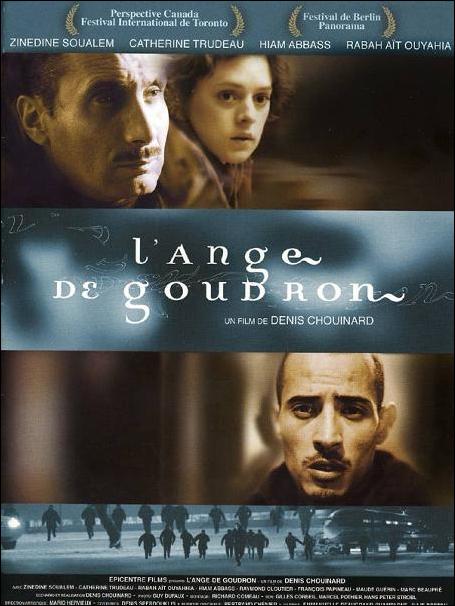
L' Ange de goudron


The only reason why I looked forward to seeing "Tar Angel" was that it had Hiam Abbas in it.. Having seen her in four or five movies till now, she had become my favourite actress from the middle-east.. i think she's Israeli.. Well the movie turned out to be worth a watch, for a lot more than her alone.
The movie begins with a scene inside a canadian mosque, where a prayer is in session, and each person who is attending the prayer looks like anyone but a canadian. Each one of them is an immmigrant into this country and almost everyone are illegal.
The Kasmis are a quiet family living their newfound lives in Canada, making the most of the little earnings the father Ahmed gets paid for operating cranes and stuff.. According to him he's privileged to just have a job on his hands... The son, Hafid has just turned 19.. goes to finishing school, the daughter has started going to school too, Hiam Abbas as Naïma is pregnant, carrying her third baby.. So the father has a job, the kids go to school, the wife is pregnant, clean records on the family, etc.. Easy for such a family to avoid deportation by the government.
Things seem to getting better for the family, until the son misteriously disappears one night and never shows up.. A few days before getting their citizenships sanctioned, Hafis is seen on television in the news channels through a cctv camera in the goverment offices. The news is about a group of radicals who have erased all data in the government offices, regarding the deportation of immigrants.. Hafid however remains as 'unidentified' in the news.. But Ahmed instantly panicks. He finds that his son has been inducted into a terrorist organization which is bent on saving the illegal immigrants from being deported to their respective countries.. He finds Huguette, Hafid's girlfriend who decides to help him find his son.. In reality its Huguette who had previously introduced Hafid into the group recently.., but somehow she never knew that he was going to be used for a suicidal mission like this, so much the reason for her help.
The movie drags a little during the middle when Ahmed, a very religious person (hell he dosen't even take wine.. in Canada!) is never at ease with Huguette, who is actually a tatoo artist.. every religious person's worst nightmares all over her and her attitude.
But once the son is found, things start to quicken. Hafid, however manages to suceed in the mission, destroying all the papers just before the immigrants leave.. However, he's beaten to death by the police officers.. right in front of his father, before he could stop his son.
The reason why I watched this movie, Hiam Abbas ended in dissatisfaction. She hardly has a role to play in here, as just a crying mother.. But the impressive performance by Zinedine Soualem and Catherine Trudeau compensate.. Immigration in Canada and france is a problem that can be examined a lot through movies lie these.. I never knew the enormity of the problem untill i saw movies like these.. Almost one third of the movies telecast on TV5 are somehow bordering on this theme..

Thursday, July 06, 2006

FREE ZONE


Motion Pictures are not one, but many genres. There are films poised solely to entertain, others to politicize, and yet others are art.

FREE ZONE is art in a film format. Just as most art, it relies more on senses, feelings, aesthetics, and perceptions. Unfortunately, for the unimaginative and unengaged, it can sometimes be unintelligible.

The film begins with a very long close-up shot of a beautiful young woman (Natalie Portman) copiously crying in the back seat of a car, to the Jewish children's rhyme "Had Gadia". The powerful arrangement in crescendos adds pathos to the girl's exteriorization of heart-felt anguish, and the seamlessly-never-ending stories of increasing consequences and characters (sung in Hebrew but appropriately subtitled) add confusion and exasperation. The sense of utter discomfiture is only compounded by the audience's utmost ignorance of the character, her surroundings, and her motivations. Her despair is our despair, but we, much as she also seems, are lost.

Slowly we learn she is parked by the Kotel, or Wailing Wall, in Jerusalem. We also learn she has just fought with her would-be mother-in-law and broken off her engagement to her Spanish-Israeli fiancé. Thus her personal loss becomes the middle-eastern mourning, and her very personal suffering symbolizes the tears and hopelessness of whole peoples and an entire land.

Immediately one is faced with a choice. To watch the rest of the movie as a narrative, or to perceive the allegory it propounds. To choose the first is to misunderstand it entirely, and miss on the powerful images and senses.

Rebecca (Natalie Portman) is an American who struggles aimlessly through life without a clear sense of identity. Her father is Jewish, but she carries little or no pride in her heritage, ignorant even of her status as a Jew (or not). She feels uneasy in her American home, and in a search for an identity that suits her, she acquires (and loses) a fiancé and a home in Israel. How she reacts to the landscape (so extensively shot, in exquisite details) and to the people (diverse, albeit through quick and superficial contacts) symbolizes the author's perception of the American (as in people or nation) own sense of identity and appreciation of the Middle East.

She joins Hannah (Hanna Laslo), a Russian-Israeli middle-aged woman whose life stories unfold piecemeal as a symbolical-historical window on the Israeli nation, on a trip to the Jordanian free trade zone on a mission for personal and familial financial salvation. Her determination and her biases (often even callousness) are obviously shaped by her pressing needs and her clear life trajectory, as evidenced by the unusually thorough (as opposed to the other characters) exposition of her past. Her reactions to her American travel mate, the obstacles in her quest, and the eventual Palestinian they meet clearly embody the Israeli national persona, dreams, fears, and strengths.

The Palestinian our heroes meet is Leila (Hiam Abbass), whose family present as Hannah's possible salvation (as in the money her husband owes her) or damnation (as in the fall-out from the misguided actions of her rebellious and contentious son). Torn between her loyalties to her own family and her duties toward this Jewish woman, she joins the other women in their quest for redemption.

The women allegorize their respective nations. And yet, their struggles are very personal and transcend national identities and interests. The combination of the three, and how they interact amongst themselves to work out their individual travails, masterfully conveys the powerful emotions in the confluence of tribes, nations, countries, and religions in this most convoluted region. The attention to the national frontiers (what role they play in segregating these peoples) juxtaposed to the more promiscuous exchange amongst the actual peoples (their representational counterparts in the characters) is quite fascinating.

The narrative is non linear, relying mostly on feelings and emotions. The filmography is untraditional (a lot of hand-held camera movements, as if the audience is privy to the story, watching a family road trip video) and experimental (long and confusing, yet dramatic, layering of images and back-plots, creating familiarity with back stories, yet maintaining distance thru the lack of clear focus or images). The plot is mostly allegorical, therefore characters are not really introduced and developed as they are thrust upon the audience (with the implication that one already knows them, or who they represent), played out in short pericopes and less of an overarching story.

The film is beautiful and insightful. If you prefer mass produced Hollywoodean one-size-fit-all entertainment, this is not the movie for you.