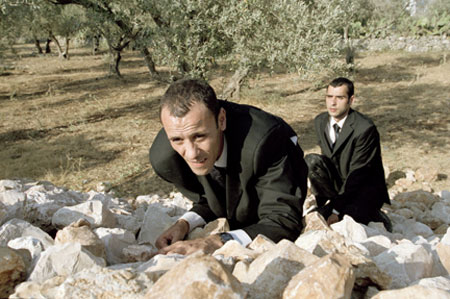
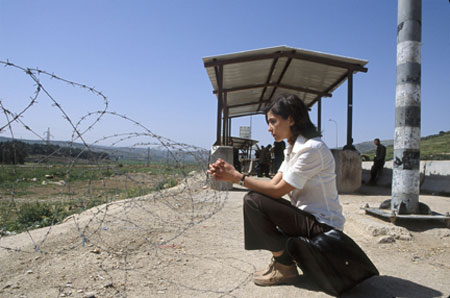
Watched this for free on www.mubi.com, and was riveted by the images I saw.
A Turkish woman embarks on a romantic journey as war breaks out in Iraq , in the tough, engaging road movie My Marlon And Brando. Billed as being 'based on a true story', the film derives its distinctive immediacy from the fact that its lead characters - star/co-writer Ayça Damgaci and Kurdish actor Hama Ali Kahn - are effectively playing themselves.
The emotionally involving love quest, a quasi-documentary element of current-affairs reportage, plus Damgaci's charismatic central turn should all make Hüseyin Karabey's film a strong contender for moderate sales straddling the art-house niche and more mainstream buyers, with TV and DVD prospects looking equally healthy. On the festival circuit, the film - receiving its world premiere in Rotterdam - should flourish, especially at events angled towards women's cinema, politics and human rights.
We first meet Damgaci when she is acting on a film shoot in the west of Turkey, where she has met Hama Ali (Kahn), a Kurdish actor. The two have fallen for each and hope to get together soon, tensions in the area allowing; the period is the run-up to the war in Iraq. Back home in Istanbul, Ayça rehearses her role in a ramshackle agit-prop stage play, and takes part in anti-Bush demonstrations. She waits eagerly for letters from her beloved, which eventually come in the form of ebullient, passionate and intermittently amusing videos, featuring Hama Ali's home-made Superman spoofs.
Because Hama Ali is prevented from travelling westwards, the only way the pair can meet is if Ayça makes the difficult trek to his home in Sülemaniye in Northern Iraq. Seeking contacts in Istanbul 's Kurdish community - and discovering how tough it is for immigrants - Ayça sets out on her journey. First she has trouble getting across the Turkish-Iraqi border, then has to make a detour into Iran, where she is disturbed to find herself hassled on the street and obliged to cover her head. Her determination never flags, although she starts to wonder whether Hama Ali shares it. That he does is revealed in a final video letter from him, ending the film on an abrupt, dramatic note that leaves us to speculate whether a happy ending is really in store for the pair.
The film's romantic content, despite its undoubted sincerity and confessional edge, is perhaps its weakest spot. The lovers communicate with each other in English, and Ayça's effusive poetic ramblings to Hama Ali take some swallowing (they are the source of the film's ungainly English title, which could profitably be changed). The duo's bond, however, comes across all the more strongly because of their separation throughout. In no way conventional screen lovers, the couple are bracingly approachable in their ordinariness. Kahn is bald, middle-aged, cheerfully buffoonish, while Damgaci is bulky, unkempt and altogether abrasive in personality - but the very embodiment of 'feisty', her determination carrying her through as a character, as it presumably did in the real events on which the film is based.
Shot on location in Turkey, Iran and northern Iraq, the film follows Ayça's travels with documentary urgency, setting her personal mission against a background of refugee migrations at the outbreak of the Iraq war. We get to see Iranian society from an angle we're not used to - from that of a Westernised woman outsider, herself from a largely Muslim culture - and Ayça's experience also imparts a sense of current Turkish idenitity, divided between Western and Eastern traditions. The DV shooting is rough and urgent, the travelogue sections featuring unvarnished and often magnificent landscape shots. The counterpoint between personal drama, and the turbulent and very tangible real-world background, make the film as level-headed and forceful as its protagonist.