Tuesday, December 19, 2006

Dance Me to My Song


I first heard of australian film director Rolf de Heer during the recently held Chennai International Film Festival and was curious as to how his movies are. This is one of six of his movies that were being screened during the festival. His themes as far as I can say are the widest. 'Dance me to my Song' was centered around a hopelessly cippled woman, 'The trapper' was around an enslaved aboriginal tribesman during the year 1922, et cetera.
'Dance me to my Song' came as a surprise to me, basically because of the levels of courage and simplicity it portrays and its sense of raw talent. You'll see why.
Julia, portrayed by Heather Rose looks like a twisted flower squeezed inside a book. For all that she can see, hear and feel, she is looked down as nothing but a mass of flesh that serves no purpose. The only way she can communicate is by using her vioce machine (whose mechanical voice which makes it sound all the more eerie!) and sometimes her eyes and some throaty noises too. Madelaine has been assigned as her caregiver, thus relieving Julia from the monotony of the nursing homes. Caregivers are rare to come by, as we learn later in this film, and Madelaine is paid well by the nursing homes for her services.
But right from the beginning of this story, the fact is established that Madelaine is a higly selfish person who gets easily irritated with Julia. There are reasons for her rudeness though: She has a very unsuccessful love life. She tries desperately to find a man and fall in love with him unconditionally. But all the romantic adventures turn out to be one-night-stands for her. She feels humiliated and cheated as often as she in turn becomes the devil to Julia. But the most heartening thing is Julia sees, hears and understands the turmoil inside her caretaker. She wants to help and tries her best, but with Madelaine becoming increasingly rude and nasty, she hates her all the same. Rix a previous caregiver for Julia who is every bit as good as Madeline is devilish towards her, meets Julia often much to Madeline's annoyance .
At this juncture, Julia meets Eddie in a very comical encounter where she blocks his path and speaks with her wheelchair, eyes and tongue asking him to help her with her toilet! Eddie in turn finds this company much to his liking, and thus begins a firm bonding between them. Julia's physical yearning for sex and love; and the way she desperately seeks for it speaks volumes about the world that's tied up inside her. Eddie understands this too.
Madeline sees this and immediately falls for the handsome Eddie. The thought of Julia having Eddie's attention all the time makes her go raving mad. It all ends up with Madeline being caught red handed by Rix and visiting officials from the nursing home while she was literally beating Julia and threatening to kill her after she found her and Eddie in bed together.

The scenes where Heather Rose is rough-handed and beaten up will make any sane person wince even if he's a terminator himself! Heather Rose is a real life example of extreme cerebral palsy, though this never deterred her from acting or scripting this movie. We see her completely undressed. Julia's nakedness conveys her vulnerability without being the least bit prurient or exploitive.
Rolf De Heer's movies are like this as I found the similarity while watching another of his masterpieces - The Trapper: One will never know how to react to any scene in the movie. Its both saddening/digusting to some while at the same time wanting to make some other frame of mind laugh ou loud. I thrice found myself laughing alone in the audience while watching The Trapper. All of his movies are a must-see.

Saturday, November 25, 2006

Cidade de Deus


This is the first portugese movie that I've seen. And its certainly one of the best and finest I've seen in a very long time, probably the best in my collection. A movie achieves it's fullest impact on you especially when you see it without reading a single review, without seeing a single picture or screenshot of it, with no idea as to how the movie is going to turn out in the next 2.5 or so hours.. That's exactly the way I saw this film. Seeing the poster, i actually was under the impression that this is going to be a story centered on themes of love! I winced, yelled, became sober and winced again by the time I was through watching this movie.

Pandeyes42 from Australia writes:

It all starts with one of the most exhilarating and allegorical opening sequences is recent film history.A chicken caught between two opposing sides.One of those opening sequences,like Danny Boyle's "Trainspotting" (1996), that simply grabs the viewer by the throat and refuses to let them go until the film is done. One of the signs of a truly great film.

Thankfully, "City Of God" quickly proves itself to be equal substance and style. One of the aspects of this film that I love so much is the way that it is very raw,candid and intimate in the story that it tells. I have read that "City of God" has been compared to Martin Scorsese's "Goodfellas"(1990). I can see the comparison in the way that both films basically put you, the viewer,smack bang in the middle of the story they tell.Both films also have that sense of edge in that they are based on true events.

Spanning three decades, the story of "City Of God" covers many aspects of a very negative type of life, that of living in one of the most dangerous slums(favelas) in Brazil. What I found so compelling about the film is the way that it's main character, Rocket, searches for a way out of his supposed predestined fate. Before he discovers photography as a career, his choices are either policeman or criminal, both about as corrupt and venal as each other.

Although confronting and disturbing, "City of God" tells its story with a very down to earth attitude and, at times, a wonderful sense of humour, never more evident when Rocket tells us about his attempt at a life of crime.There is some beautiful writing throughout the film which really makes the viewer give a damn about its characters.

"City of God" is that rare film where the visual style fits the material perfectly. Watch the way that the optimism and innocence of the first part of the film, particularly the depiction of 'the tender trio', is contrasted against events after Lil Dice shows his true colours during the hotel robbery.

The use of a largely non-professional cast also absolutely rammed home this story for me. As a viewer, the worldly wise experience and attitude of a great deal of the cast really shone through. An absolutely gut wrenching moment that illustrates this perfectly would have to be Benny's going away party and its abrupt, shocking ending.To me, Benny was one of the more sympathetic characters in the film.For his life to be taken just as he was finding a way out of the 'ghetto thug life' hits the viewer right between the eyes. It is symbolic of the point of change within the story's framework. In "Goodfellas", Tommy's death was very similarly used.

Like one of my other films that I would say is one of the best of the decade so far, Darren Aronofsky's "Requiem For A Dream" (2000), "City of God" shows how its characters are attracted to something so negative such as gang life and criminal behaviour, while at the same time showing what happens when attraction turns into repulsion; the dream becomes a nightmare.

The clarity with which this is shown in both "Requiem" and "City of God" is something I admired greatly in both films. The ability of both filmmakers concerned to be impartial and non-judgemental in the subject matter at the cores of their respective films impressed me in both "Requiem" and "City of God".The subjects of both films, drug use and gang life respectively, are subjects that,via their films, make filmmakers either glamorize or preach in regards to how they depict their stories.One of the greatest strengths of this film is its absolute refusal to compromise or sugar coat its depiction of life in the slums.At the same time,I found "City of God" a very positive and hopeful film. The just about prefect final scene shows this. Rocket finally finding a way out of the slums and moving forward with his life, contrasted with the 'runts' planning their death list and how they're going to run the favela. This shows how one can achieve positive things in their life if they choose to do so, or take the easy option and follow what has gone before in their lives, even if it is a very negative thing to do.A very haunting and moving way to end a truly remarkable film.

As someone who loves cinema, I wish more films were this forceful and impassioned. Films like this remind me why I love cinema as much as I do.

L'Enfant


I first heard of L'Enfant through the TIFF website which contains a whole load of such movies. The Dardennes brothers have often been criticized for their Marxist views on the society. They have always been known to portray society in its stark utter realism, especially the part of the society that lies low, real low in its standard of living, below the poverty line. They are better known for their first masterpiece Rosetta that also won a lot of accolades, awards and brought them a lot of recognition.

Industrialized societies have created a phenomenon among the young people that drop out from their midst, an aimless class without direction. Most of these youths will go into crime as the only means to survive their meager existences. They will also enter into relationships with other young people and produce illegitimate children, which is the subject at the center of this magnificent film by Jean Pierre and Luc Dardenne.

Sonia, the young mother, is seen as the film opens looking for Bruno, the father of her infant son. It is clear, by the way we see Sonia take care of the baby, she is a mother who loves her son. Bruno, on the other hand, a petty thief, couldn't care less about this son, who probably looks not real to him, or at least, he cannot relate to the child's presence in his life.

Bruno, and the young teen agers that he befriends, are partners in crime in stealing whatever come their way. Bruno, who obviously has no scruples, doesn't think anything when he learns about the lucrative market for selling babies to criminals that are willing to pay a lot of money in order to get them. Selling his own son means nothing to him.

What Bruno doesn't count on is on Sonia's reaction, as she collapses in front of his eyes when he informs her about what he has done. The shock alone sends Sonia into the hospital where she is inconsolable for the great loss she has suffered. Seeing her in the state she is triggers in Bruno a reaction into getting back the baby. He gets the infant back, but the criminals involved in the deal will make him pay dearly for the business he took away from them.

The last straw that unravels Bruno is the street mugging with young Steve in which, unknown to him, people go after him in a chase that takes the duo into the river. Steve, who suffers a cold shock from the water, almost drowns from the experience. When Bruno confesses to the crime, he does the only decent thing he has done in his life. The final scene shows Sonia, who has come to visit him in prison with their son, and Bruno who finally understand the enormity of his crime and his guilt.

Jeremie Renier makes a good impression as Bruno. As the careless drifter, Mr. Renier does some of the best work of his career. He is totally believable as the petty criminal and predator. Deborah Francois captured Sonia and the love she felt for her son. Jeremie Segard is seen as Steve, Bruno's contact and partner in crime.

Jean Pierre and Luc Dardenne are film makers that deal in real situations like the one they present us here. "L'Enfant" is one of the best films they have done because the intensity they bring to the story that shows that even a hardened criminal can redeem himself when he understand the enormity of his crime.

Frankly I was a bit disappionted at this movie's very predictable plot. The name itself L'Enfant i think is meant more towards the young couple shown in this movie, rather than the baby itself.. Jeremie Reiner does look stupid and a bit too desperate towards his wife, especially when the falls at her feet and refuses to let go of her ankles! But otherwise, this rather subtle movie is watchable once. Just for the dardennes.. Review courtesy of a guy called Jotix100 from New York.

Sunday, November 19, 2006

Lucia y el Sexo


Lucia y el Sexo is one of those films that aims to confuse. Just when you go down a rabbit-hole of confusion... literally. As perceptions begin to form effortlessly about every movie I watch before I even get my hands on it, I promptly hesitated on the verge of seeing this movie especially when it comes with this -> NC-17, The reviews I read were anywhere but between the extremes- either they call it a blundering erotic rollercoaster (the anglais speaking world), or its the opposite: a timeless work of art and creativity (the cinema-loving world). Some call the director Julio Medem one of the most "earthiest" in a country noted for its hearty cinematic eroticism. But one thing was evident: there definetly is going to be a lot of disturbingly erotic sequences in this insanely layered story. My previous encounter with such levels of endless, unforgiving, graphic imagery was when I watched Michael Winterbottom's 9 songs that left me, say quite unbalanced. But that was for a reason- I never managed to follow any plot whatsoever in it. Not even till today. That's not the case when it comes to Lucia y el Sexo. In fact the story is what is more captivating and excellently executed than all those wild moments in this movie that can cause that oh so familiar rush of blood to.. Thats what I inferred from the reviews and believe me, I was correct! At the end of the day it's up to the viewer what to make of it all. I happened to see an english dubbed version on abc last week. I think i'll download it right away..

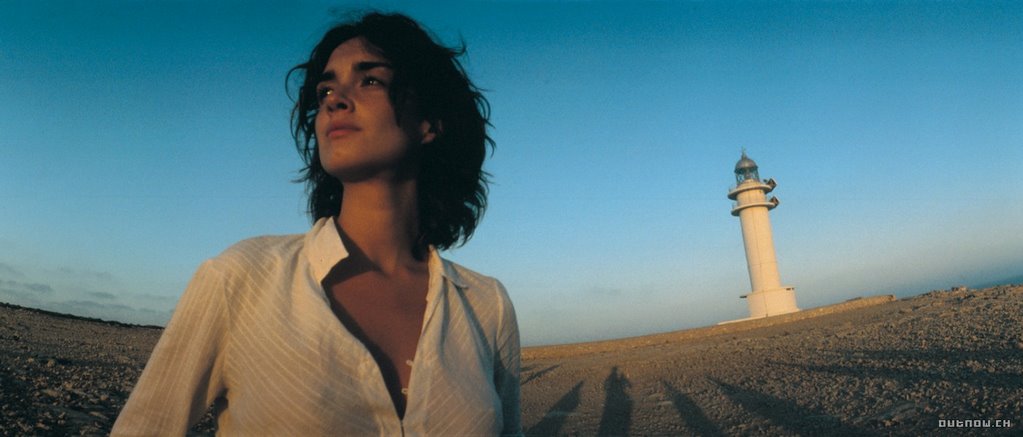
"I'm sorry for everything I said when I left," a pretty young waitress whispers into a pay phone at the back of her restaurant in the opening scene of "Lucia y el Sexo." Regret and apprehension resonate in her voice. Her body is both tense and tired, not from too little sleep (although that's probably a part of it) but from the fatigue of having strain she can't resolve in a relationship that has been the most important thing in her life.

All of this is evident within seconds of this girl's presence on screen, so it's no wonder the composed yet sensual and expressive Paz Vega won a Goya (Spain's Oscar) for this performance. She goes on to cover a remarkable range of emotion, strength and vulnerability as the lovely Lucia, who by the end of that phone call has sensed desperate despondency in her already deeply-troubled lover. She dashes home to find a disturbing farewell note just as the phone rings with a call from the police expressing regret about an horrible automobile accident....
Lucia hangs up in the middle of the call, hastily packs a backpack and runs away to the only place she can think of that might put her heart at rest -- an island off the coast that Lorenzo (Tristan Ulloa), her lover, had always talked about but never taken her to visit.

Adept at plumping the depths of love and loss, "Lucia y el Sexo's" writer-director Julio Medem ("Lovers of the Arctic Circle") also has a talent for entrancing visuals and a penchant for extraordinary twist of fate. At the same time that Lucia is reaching the island -- a parched Mediterranean paradise of crystal blue seas and rocky cliff tops, photographed in transporting, heat-baked, sun-bleached colors -- Medem flashes back to six years before, when Lorenzo spent his 26th birthday on the island, making love in the ocean to a local girl with whom he didn't exchange names.

Completely unaware of the connection, on her solace-seeking trip in the present, Lucia befriends this same woman, a seemingly free spirit named Elena (Najwa Nimri from "Arctic Circle" and "Open Your Eyes") who is, in fact, also hiding from the memory of a personal catastrophe.
Medem then intertwines Lucia's emotional convalescence with the histories of all three characters in a heart-catching, hair-pin-curving narrative of circumstance, coincidence and destiny. Young Lucia's giddy, unorthodox seduction of Lorenzo -- a novelist she admired so much she resolved to make him fall in love with her -- is part of the story, as is their passionate, sexually adventurous love affair. Lorenzo's fortuitous discovery that he has a daughter -- a fact he withholds this from Lucia -- and a terrible tragedy that is an indirect result of this knowledge, sends the haunted writer into an emotional tailspin that begins to bring the film's themes full-circle.

Profound performances by Vega (who looks like a younger, fresher, more pithy Penelope Cruz), Ulloa and Nimri give the film such a compelling intimacy that it feels as if the emotions are wafting off the screen. This is especially true of the many carnal love scenes as if Lorenzo and Lucia. Bee-stung pixie Elena Anaya -- another Goya nominee for the film -- also makes an unforgettable impression as the little girl's babysitter, a sexual siren who ensnares Lorenzo as he tries to bond with his child surreptitiously.

At times Medem over-reaches in his quest for empathetic intensity. A character-establishing peripheral storyline about the babysitter being turned on by watching old porno movies starring her mom is excessive and ultimately unnecessary to the plot. The film is not well served by an on-camera birth scene that leaves nothing to the imagination. One more complaint: Because the audience is privy to connections that the characters are not, the last act drags a little while we wait for the other shoe to drop.

But the captivating psychological journeys in "Lucia y el Sexo" -- which contain far more intricacies and surprises than I've described here -- and Medem's remarkable, metaphorical filmmaking style make it possible to overlook such impediments and just let the picture's potency wash over you like the warm Mediterranean waters.

Courtesy of RB, whatever he/she is...

Friday, November 10, 2006

Samsara (2001)


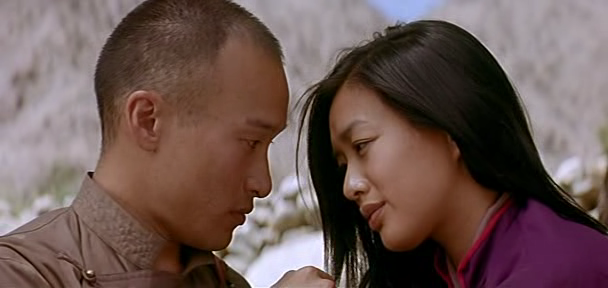
Buddhism deals with birth, suffering and death and the unending life cycle is called Samsara. Buddha left his prince hood to seek an answer for the unending sufferings that he saw all around him. After the enlightenment, he said it is desire, the cause of all our miseries…so get rid of the desires…get rid of the world that you live in. Shut up in a cave and meditate. That's what we see first in this movie. Tashi, who was n a long meditation (for three years, three months, three weeks and three days) inside a cave in the Himalayas, is taken back to the monastery. After meeting with a village girl, he demands for a freedom to follow his carnal desires stating even Buddha had them until the age of 29. Seeing his lack of concentration in monastery duties and frequent wet dreams, the spiritual adviser grants him his freedom to find out life and make a decision on it. This makes up the first segment of the movie and it goes almost one hour.

The second segment is Tashi's marriage with Pema, and his life as a husband and father. This segment also runs for one hour and the final segment, which includes the conversation between Pema and Tashi, summarizes the whole point of the movie and lasts for about ten minutes. This is about the structure of Samsara. This is photographed in the high altitude locations in Ladakh in Kashmir and is very pleasant to watch. The narration is slow paced, which is apt for the spiritual content of the film. The love scenes were also photographed well and the music score was spiritual.

Samsara talks about the eternal conflict, the one between the flesh and spirit and at some point it grows to question the Buddha himself on a feminist perspective, by creating identical situations. At some point in the monastery segment, we hear a question, how do you keep a drop of water from ever drying up...? At the finishing of the movie, we get the answer, as carved on the back of a stone...By sending it into the sea. This can be read in two dimensions as well. How do you keep your carnal desires burning…? By indulging in them frequently. How do you keep your spirit alive? By immersing it into an ocean of spiritual activities. This is how I read Samsara. Samsara brings up some of the unanswered questions on whether Buddha was right to leave his family and impose the same sufferings onto the one who loved him. I think Buddha himself was confused after his enlightenment, and this confusion led to the great split among his followers towards Mahayana and Heenayana.

What I really liked about this film also is the fact that it presented us with the female point of view in the final monologue of Tashi's wife Pema. She was given no choice from him when he decided to go back to the monastery. She had to stay behind and take care of their son. She was shown to us as the keeper of the traditions (not allowing her son to play with the modern toy his father bought him from Leh) but at the same time she had that free spirit to make love to the unknown Lama and afterward to even marry him. I liked the sensitivity of the writer / director who cared not only to show us the pain of Pema when realizing she's losing his husband, but also to make her an intelligent woman who thinks and who turns out be as wise and devoted as her Lama husband.

It's less important whether you get any answers...and Samsara is one of the finest movies in recent years.

Lora Traykova